Kategorien durchsuchen
Entdecken
Fiverr Pro
Deutsch
$
USD
PCB Design Engineer
HELLO AND WELCOME!!!
Are you looking to engineer the next generation of wearable vision or smart connected hardware? I am a professional hardware electronics engineer specializing in designing ultra-compact, high-density PCBs for AI smart goggles, Augmented Reality (AR) eyewear, and complex IoT prototypes.
From micro-display power management to embedded computer vision systems, I transform futuristic concepts into optimized, production-ready circuit architectures.
What I Offer
Why Choose Me?
Don't let signal interference or tight spacing derail your smart eyewear project. Message me before placing order to discuss and to share your physical design constraints, display specs, or component ideas. Let's map out a flawless hardware architecture for your AI smart goggles.
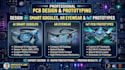
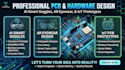

Space is extremely limited inside my eyewear frame. How do you handle this?
I specialize in HDI (High-Density Interconnect) layouts, using advanced techniques like microvias, blind/buried vias, and fine-pitch BGA component placement. I also leverage rigid-flex PCBs, which allow the circuit board to bend and slide right into the curved temples or frame of the goggles.
How do you handle the high-speed data from cameras and AR displays?
For AR eyewear, maintaining signal integrity is critical. I implement precise controlled impedance layouts and length-matching for high-speed protocols like MIPI CSI (for cameras) and MIPI DSI or SPI (for micro-OLED/MicroLED displays) to completely eliminate screen flickering or data corruption.
Smart goggles sit right on the face. How do you prevent them from overheating?
Thermal management is a top priority for facial wearables. I use strategic thermal vias, copper pours to dissipate heat away from the face, and select ultra-low-power components to keep the thermal signature as low as possible.
Which edge-AI hardware modules do you design with?
I frequently work with space-conscious, AI-capable hardware like the ESP32-S3 (for light computer vision), Kneron edge-AI chips, or advanced ARM Cortex-M55/M85 processors with integrated neural network accelerators.


