Kategorien durchsuchen
Entdecken
Fiverr Pro
Deutsch
$
USD

Aeronautical Engineering
Kompetenzen
Meine Dienstleistungen

Freelancing Career
Teilzeit • 7 yrs 3 mos
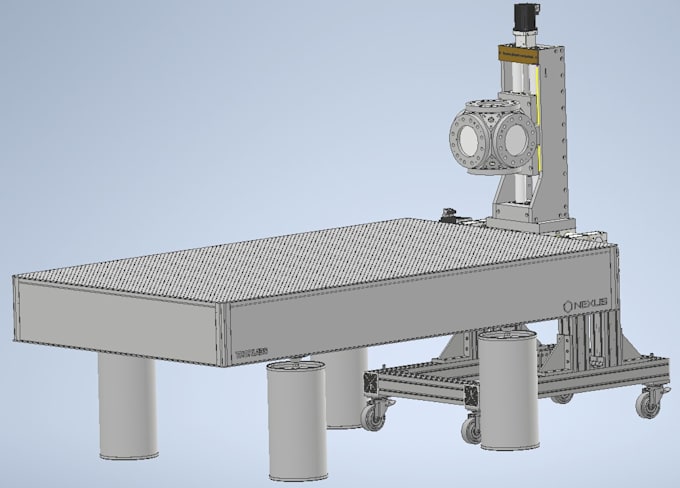
Construction and functional testing of a 2-axis traversing system for an injection test bench
Oct 2022 - Present • 3 yrs 7 mos
In my bachelor’s thesis, I was responsible for the CAD-based development and implementation of a two-axis traversal system for an injection test bench used in thermodynamic research . The project involved the complete design and integration of a mechanical system that allows precise horizontal and vertical positioning of a heavy injection chamber. I started by digitizing existing hardware components into accurate CAD models, which served as the basis for all further design work. I designed the full supporting structure using aluminum profiles, ensuring stability, modularity, and compatibility with an optical measurement table. A major focus was on developing custom mechanical components such as flanges, reinforcement structures, and mounting solutions. A key part of my work was the creation of detailed, production-ready technical drawings. These included precise dimensioning, tolerancing, and all necessary information to ensure that parts could be manufactured and assembled without errors. Additionally, I optimized the designs for manufacturability, carefully aligning geometries and interfaces to avoid costly rework during production. Beyond design, I was also involved in the physical assembly and functional testing of the system, including the integration of motorized linear axes and control components. This project strengthened my ability to create precise CAD models and translate them into reliable technical drawings that can be directly used in manufacturing.
Design and construction of a mobile high-performance compressed air supply for an engine test stand
Oct 2022 - Present • 3 yrs 7 mos
In a project work, I was responsible for the CAD-based design and development of a mobile protective and transport structure for an industrial air compressor used in a test environment . The objective was to transform a previously stationary system into a fully mobile and robust unit while ensuring safe operation and mechanical protection. The design had to meet multiple requirements, including mobility via wheels, forklift handling, crane lifting capability, and structural integrity under dynamic loads. I developed the complete welded steel frame structure in Autodesk Inventor, focusing on stiffness, load distribution, and safe force transmission. This included the design of key components such as compressor mounts with vibration damping, reinforced wheel carriers, forklift pockets, and crane lifting points. A major part of the work was the creation of detailed, production-ready technical drawings. These included precise dimensioning, tolerancing, and all necessary information for manufacturing and welding, ensuring accurate fabrication and assembly of the structure. Additionally, I considered real-world constraints such as transport dimensions, accessibility, and maintenance, integrating all functional components (e.g. electrical control cabinet and power supply) into the design. This project strengthened my ability to design robust mechanical systems and, in particular, to create reliable technical drawings that directly support manufacturing and practical implementation.
CAD Design of an Engineering Exhibition Model
Jul 2023 - Aug 2023 • 1 mo
The company Name is Freudenberg Sealing Technologies During my internship, I was responsible for the CAD-based design and development of an exhibition model to demonstrate the advantages of a proprietary sealing solution compared to conventional designs. Working with Autodesk Inventor, I created a complete assembly consisting of multiple subassemblies and both standard and custom-designed components. The task required integrating purchased parts as well as designing new components to ensure proper functionality and clear visualization of the concept. A key part of my work was the creation of detailed technical drawings for manufacturing, including proper dimensioning and consideration of assembly requirements. Throughout the project, I developed a strong understanding of practical mechanical design challenges, such as bearing selection, guiding rotating components, and ensuring structural stability through appropriate fastening concepts. I also learned to design with real-world constraints in mind, focusing on manufacturability and cost efficiency. Early design iterations were refined to reduce unnecessary material usage and simplify production. This project significantly improved my ability to translate theoretical concepts into functional CAD models and precise technical drawings suitable for real-world implementation.
