Kategorien durchsuchen
Entdecken
Fiverr Pro
Deutsch
$
USD


Gig Description
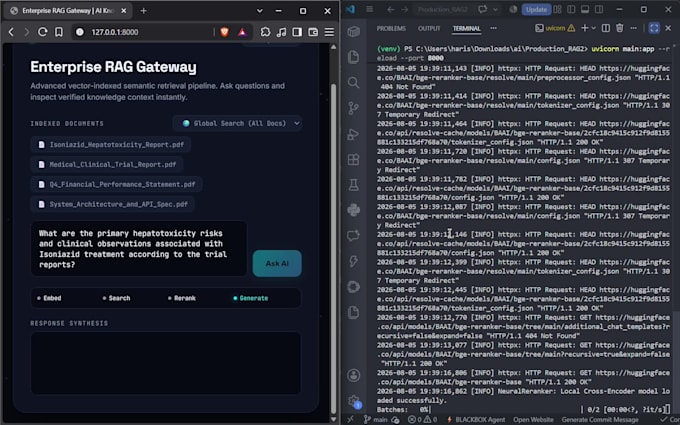
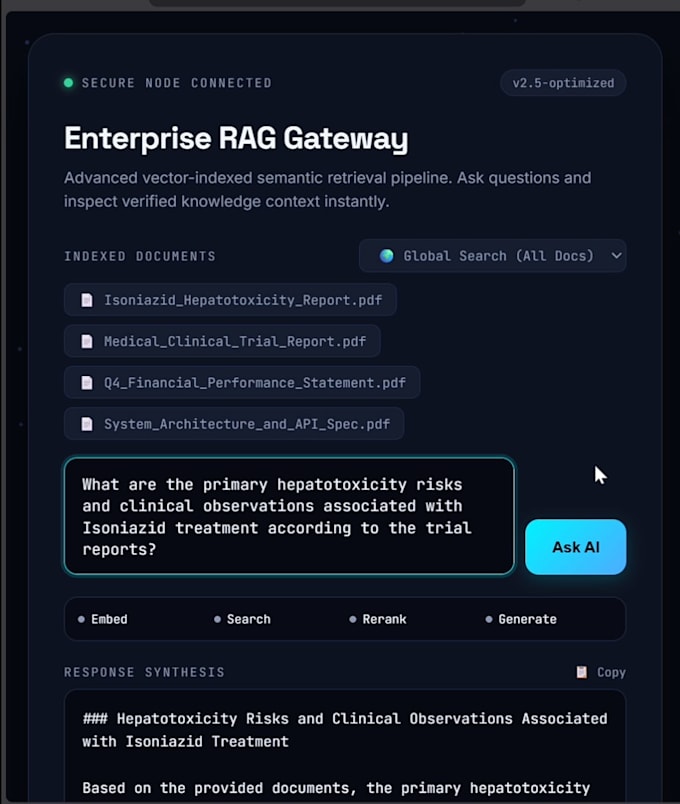
Do you want an AI that can chat with your PDFs, documents, or database accurately? I will build a production-ready RAG system for your business...
I specialize in production GenAI architectures and asynchronous backend systems using Python, FastAPI, Vector DBs, and LLMs (OpenAI, Groq, Llama 3).
️ Core Capabilities:
Tech Stack:
Python | FastAPI | Qdrant | Pinecone | LlamaIndex | LangChain | OpenAI | Groq | Docker
Why Choose Me?
Let's discuss your project! Drop me a message before placing an order so we can tailor the architecture to your specific data needs.
Enterprise Rag and AI Systems Engineer
Sprachen
Q1: What prerequisites do I need to provide before starting?
Answer: You will need to share your project specifications, sample data/documents, and API keys for the chosen LLM or Vector DB providers (e.g., OpenAI, Groq, Pinecone). If you don't have keys ready, I can guide you on setting them up safely in a .env file.
Q2: Will my data and API keys remain secure during development?
Answer: Yes, absolutely. Your data, business logic, and credentials remain 100% confidential. All sensitive credentials are loaded via environment variables (.env) and are never hardcoded or shared.
Q3: Can you handle custom document parsing like complex tables and PDFs?
Answer: Yes. I use layout-aware parsing tools (like LlamaParse) and custom chunking strategies to cleanly extract and structure tables, PDFs, Markdown, and text documents before indexing into the vector database.
Q4: Is the application ready for cloud deployment?
Answer: Yes. Every deliverable includes structured Python code, FastAPI endpoints, a .env.example template, and an optimized Dockerfile so you can instantly deploy to AWS, GCP, Azure, or any local server.
Q5: What happens if an LLM provider goes down or hits rate limits?
Answer: I build built-in resilience using retry algorithms and multi-provider failover routing (e.g., automatically switching from Groq to OpenAI if rate limits are hit) to ensure high uptime.