Kategorien durchsuchen
Entdecken
Fiverr Pro
Deutsch
$
USD




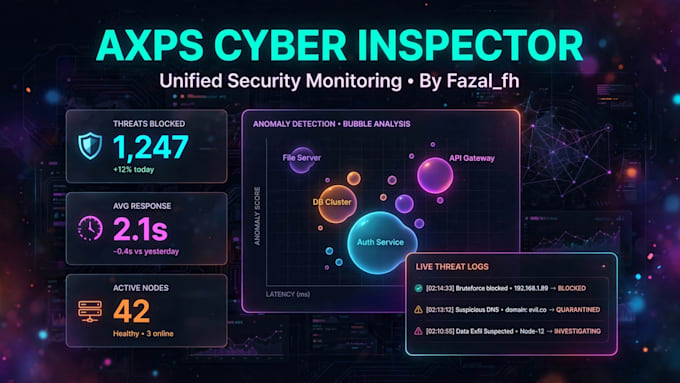
Welcome to an elite technical hub for high-performance Python Cybersecurity Architecture and AI-driven Log Inspection.
Are you seeking to convert complex, high-velocity network logs into pristine, executive-ready analytical dashboards? Or do you require robust, automated scripts to parse multi-format system logs and isolate network anomalies? You have arrived at the definitive solution.
I specialize in engineering tailored cybersecurity visualization ecosystems and secure backend Python tracking applications leveraging Streamlit.
️ PROFESSIONAL CAPABILITIES:
Log Ingestion: Advanced Python engines to parse multi-source data streams (Syslog, JSON, CSV).
Security Dashboards: High-tech, responsive user interfaces to map system anomalies and display live metrics.
Intelligent Telemetry: Custom visual indicators, risk-level matrixes, and data filters.
WHY CHOOSE ME?
Bridging the Gap: Expertly translating complex algorithmic logic and AI research into clean Python implementations.
Security-First Paradigm: Absolute commitment to code integrity for secure deployment environments.
Let's transform your specifications into a production-ready defensive interface. Message me today.
Python and AI Automation for Real Businesses
Sprachen
Q1: Do I need to grant live access to our production server or corporate network?
No. To maintain data privacy, you only need to provide a sanitized, non-sensitive sample snippet of your log data structure. I will calibrate the parsing engine to map perfectly to that format.
Q2: Is the Streamlit dashboard equipped to manage heavy, real-time data throughput?
Yes. For intensive corporate data environments, I architect the backend using Python multi-threading protocols. This keeps the frontend UI ultra-responsive without dropping critical network packets.
Q3: Where will the finished security application be hosted?
Given the sensitive nature of cybersecurity data, it is recommended to host the application locally behind your corporate firewall or within your secure private cloud. I provide full deployment blueprints.
Q4: Which core Python libraries and frameworks form the foundation of your builds?
The graphical interface is engineered entirely via Streamlit. The core analytical engine relies heavily on Pandas and optimized data-processing libraries to ensure high-speed log ingestion.
Q5: Can you integrate open-source or localized AI models for automated threat summaries?
Yes, I can integrate localized LLM frameworks (such as Ollama or Hugging Face) into your pipeline to generate intelligent incident summaries locally on your server without using external APIs.
Q6: Will the delivered application include fully documented source code?
Yes. Every delivery tier includes clean, modular, and fully documented Python source code adhering strictly to industry-standard programming conventions, ensuring easy long-term maintenance.
Q7: Do your analytical dashboards support custom alert triggers or notification systems?
Yes. In the advanced implementation tiers, the system can be configured to execute specific programmatic triggers—such as flagging critical risk thresholds—the moment an anomaly is detected
Q8: What happens if my log files change formats or add new parameters in the future?
The ingestion logic is distinctly isolated from the visualization UI. This modular approach allows your technical team to update target data parameters seamlessly without breaking the visual interface.
Q9: Do you assist with the final server configuration and application launch?
Yes. Our Premium tier explicitly includes dedicated deployment guidance. I provide step-by-step documentation and environment scripts to ensure the platform initializes flawlessly.
Q10: Can you modify or debug an existing, broken Python security script?
Yes, legacy code optimization and bug remediation fall within my core competencies. If your script is experiencing parsing issues or memory leaks under heavy loads, I can refactor the logic.